How to Train a Marker Word: The Secret to Perfect Timing
What is a Marker (or Event Marker)?
In dog training, a marker (also known as a conditioned reinforcer or event marker) is a distinct, short signal that pinpoints the exact millisecond your puppy performs a desired behavior. It acts just like taking a mental snapshot with a camera!
The marker tells your puppy two critical pieces of information:
- "THAT exact motion you just did right now is what earned the reward!"
- "A delicious treat is guaranteed and on its way to you!"
Why We Use a Marker: The Science of Timing
Puppies learn by immediate association. A dog connects a consequence (a treat or praise) to whatever action they are performing at the exact moment the reward arrives. If your puppy sits, but you spend 3 seconds fumbling in your pocket for a treat while your puppy stands up and barks, you inadvertently reward standing and barking—not the sit!
Here is why using a marker is a total game-changer for puppy training:
- Bridges the Time Gap: The marker instantly freezes the moment of success, giving you several seconds to calmly retrieve and deliver the treat without losing the teaching moment.
- Eliminates Ambiguity: It removes confusion, making it crystal clear to your puppy which exact movement earned the prize.
- Dramatically Speeds Up Learning: Dogs trained with event markers learn new skills up to 50% faster because they aren't guessing what you want!
- Builds Enthusiasm & Problem Solving: The marker creates a burst of dopamine in the brain, turning training into an exciting game where your puppy actively tries to figure out how to get you to make the sound again.
Verbal Marker ("YES!") vs. Clicker Training
There are two primary tools used as markers in modern reward-based training: a verbal marker word and a mechanical clicker. Both are fantastic, and understanding their unique strengths helps you choose what works best for you:
1. The Clicker (Clicker Training)
A clicker is a small plastic device that makes a sharp, distinct two-tone "click-clack" sound when pressed.
- Pros: Extremely precise, neutral, and consistent. Unlike human voices—which change pitch, tone, or emotion depending on our mood—a clicker sounds 100% identical every single time. This clarity makes clicker training unbeatable for complex behaviors, trick shaping, or precise positioning.
- Cons: Requires an extra hand to hold the clicker alongside the lead and treat pouch.
2. The Verbal Marker (e.g., "YES!")
A verbal marker is a short, crisp, upbeat single syllable word like "YES!", "NICE!", or "FREE!".
- Pros: Highly convenient! Your voice is always with you on walks, in the park, or around the house when your hands are full.
- Cons: We must ensure we say it in a short, upbeat, consistent tone, rather than a drawn-out "Yeeees good boyyyy," which loses precision.
How to "Charge" (Load) Your Marker Word or Clicker
Before your puppy understands that a click or "YES!" means food is coming, you must teach them the association. This process is called charging the marker:
- Find a Quiet Environment: Stand with your puppy in a calm room with zero distractions and a pouch of high-value treats (like small cubes of cooked chicken or cheese).
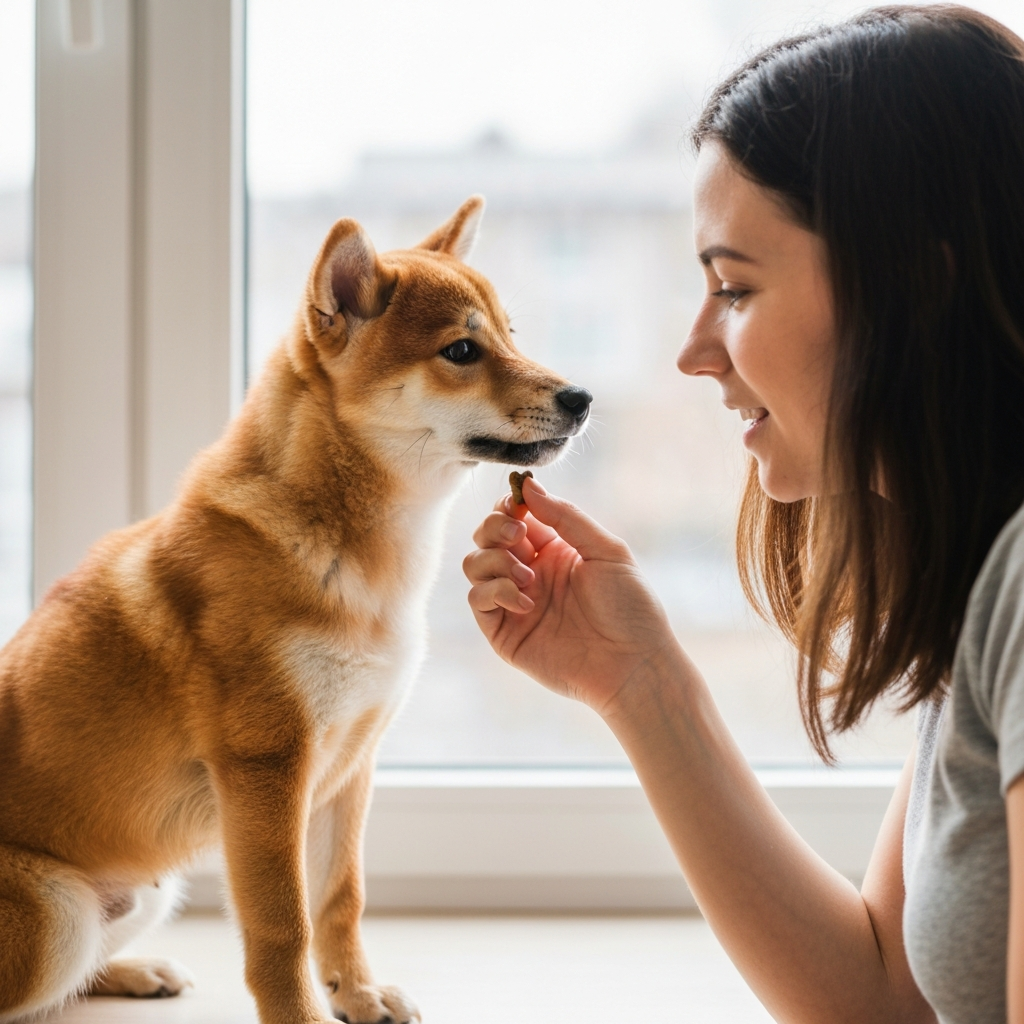
- Mark then Treat: Say "YES!" (or press the clicker once), pause for half a second, then immediately hand your puppy a treat. Do not ask for any behavior—just Mark -> Treat!
- Repeat 10–15 Times: Repeat this simple sequence: "YES!" -> Treat ... "YES!" -> Treat.
- Test the Connection: Wait until your puppy looks away or sniffs the floor. Say "YES!" or click once. If your puppy's head snaps around instantly with bright eyes, looking straight at your hand for food, congratulations! Your marker is officially charged!
Golden Rules of Marker Training
- The 1-to-1 Contract: 1 Mark = 1 Treat. Always! Even if you mark by accident or at the wrong moment, you MUST deliver the treat. Honoring this contract maintains absolute trust in the signal.
- Mark DURING the Behavior, Treat AFTER: Make the mark sound at the exact instant the desirable behavior happens (e.g., the moment all 4 paws land on the floor), then follow with the treat.
- Keep it Short & Crisp: A marker should be a quick snapshot sound ("YES!"), not a long drawn-out sentence. Save vocal praise for after the reward!
Are you looking for puppy training In Solihull?
If so, book a free call and lets chat.
Book a free call