The Core Principles of House Training
House training boils down to three simple, unwavering elements: preventing indoor mistakes through diligent supervision, taking your puppy outside frequently on a predictable schedule, and rewarding outdoor success instantly!
Puppies are not born with an innate understanding that rugs and wooden floors are off-limits for toileting. To an 8-week-old puppy, carpet feels soft and absorbent—much like grass! It is our responsibility as owners to teach them where we want them to go and build a strong habit of toileting outside.
Understanding Puppy Bladder Physiology & Timelines
A puppy's bladder muscles and sphincter control are not fully physically developed until around 4 to 6 months of age. Expecting an 8-week-old puppy to "hold it" for hours is biologically impossible.
A helpful rule of thumb for bladder capacity is: 1 hour per month of age as an absolute maximum limit while resting. However, when active, awake, and playing, that timeline drops dramatically!
When MUST Your Puppy Go Outside?
- Immediately upon waking up: First thing in the morning and after EVERY daytime nap.
- 5 to 15 minutes after eating: Food in the stomach triggers the gastrocolic reflex, prompting bowel movements.
- Immediately after drinking water: Liquid passes through young puppies rapidly.
- During and right after play sessions: Excitement stimulates the bladder.
- Every 20 to 30 minutes in between: When active in the house.
Golden Rule: Don't Make the Garden Fun BEFORE They Toilet!
One of the biggest mistakes puppy owners make is opening the back door and letting the puppy run wild in the garden straight away. If the garden is an instant playground filled with zooming around, chasing leaves, sniffing plants, or playing fetch, your puppy's brain will be flooded with adrenaline and excitement. They will completely forget they need the toilet!
Then, the second you bring them back indoors where it's quiet and calm, their body relaxes—and they immediately wee on the living room rug!
The Fix: Garden trips must be strictly business first. Take your puppy out on a lead to their dedicated toilet spot. Stand still like a statue and do not engage in play, throw toys, or chat. Once they have successfully toileted and received their reward, ONLY THEN do you unclip the lead and make the garden fun with games and exploration as an extra bonus!
Teaching & Using a Toileting Cue Word
Having a puppy that toilets on cue is a superpower—especially on cold, rainy winter nights or right before a long car journey! You can easily teach a toileting cue using simple classical conditioning:
- Choose One Consistent Phrase: Pick a phrase like "Go toilet", "Busy busy", or "Be quick". Ensure everyone in the household uses the exact same cue.
- Timing is Everything: Do NOT shout the cue when you first step outside, or you will distract the puppy from sniffing. Instead, wait until the puppy naturally squats or lifts a leg. As they begin toileting, say your cue word ONCE in a calm, gentle tone.
- Pair with High-Value Rewards: The second they finish, give them a delicious treat (chicken, hot dog, or cheese) within 2 seconds.
- Building the Association: After repeating this 20–30 times, your puppy will associate the cue phrase with the act of toileting and the reward that follows. Eventually, saying the cue when stepping onto the grass will trigger the urge to go!
Step-by-Step House Training Protocol
Following a structured step-by-step process ensures your puppy understands what is expected of them without confusion:
- Designate One Specific Toilet Spot: Pick a quiet, easily accessible spot in your garden. Always take your puppy to this exact spot so scent cues help trigger the urge to go.
- Clip On the Lead: Always take your puppy outside on a lead. If you let them free-roam in the garden, they will get distracted sniffing leaves, chasing bugs, or playing with sticks rather than focusing on toileting.
- Stand Quietly and Wait: Stand still like a tree in your toilet spot. Give your puppy a 6-foot radius to sniff around. Do not play, throw balls, or chat excitedly until they have toileted.
- Use Your Cue Word: As your puppy starts to go, deliver your chosen cue word (e.g. "Busy busy") in a quiet, encouraging tone.
- The 2-Second High-Value Reward: The millisecond your puppy finishes toileting, deliver a high-value treat (like sausage or chicken) within 2 seconds, accompanied by warm, soft praise!
Why You Should Skip Puppy Pads Entirely
While puppy pads are marketed as an essential puppy item, professional trainers strongly advise against using them in almost all home situations.
Here is why puppy pads sabotage house training:
- They Teach Indoors Toileting: Pads teach your puppy that it is acceptable to toilet inside the home on soft, absorbent materials.
- Material Confusion: A puppy cannot distinguish the difference between a white paper puppy pad, a plush living room rug, a bathmat, a dog bed, or a cozy duvet. To a puppy, they all feel identical underfoot!
- Double the Work: Using pads means you have to train your puppy twice: first to use the pad indoors, and then a second time to transition off the pad and go outside.
Skip puppy pads from Day 1! Focus 100% of your energy on direct outdoor routine and supervision to establish clean, reliable habits from the start.
Recognising Subtle Pre-Toilet Signals
Puppies rarely announce they need the toilet with a clear whine or bark at the door in the early weeks. Instead, you need to learn their subtle body language signs:
- Sudden intense sniffing of the floor in tight circles.
- Abruptly stopping mid-play or walking away to a quiet corner.
- Fidgeting, restlessness, or wandering towards the hallway/doors.
- Squatting low or lowering their hindquarters.
If you notice any of these signs, don't wait! Gently scoop your puppy up or guide them outside immediately.
What To Do When Indoor Accidents Happen
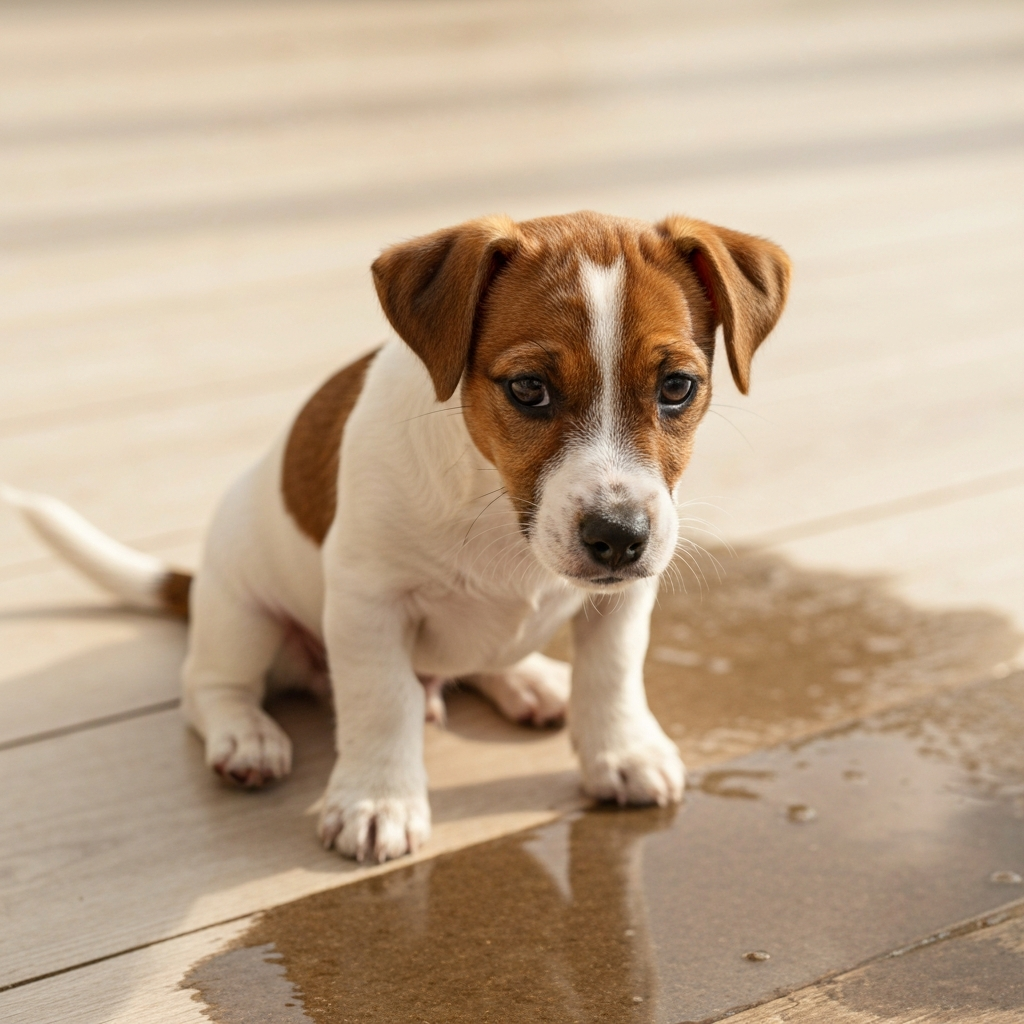
Accidents are an inevitable part of raising a puppy. How you handle them dictates how quickly house training progresses.
NEVER Punish an Accident
Never shout "NO!", clap loudly, or rub your puppy's nose in pee. Research and behavioral science prove that punishment does NOT teach a puppy to toilet outside. Instead, it teaches them that toileting in front of you is dangerous! This results in puppies hiding behind sofas or under beds to pee secretly where you can't see them.
The Correct Cleanup Procedure
- Remain calm and neutral—no drama, no shouting.
- Quietly move your puppy to another room or pen.
- Use an Enzymatic Cleaner: Standard household cleaners containing bleach or ammonia leave urine protein scent markers behind that scent-sensitive puppies can smell. An enzymatic cleaner completely breaks down the organic compounds, eliminating the scent marker that attracts them back to the same spot.
The "Outside-Inside-Outside" 5-Minute Reset Trick
A classic frustration for new owners is taking a puppy outside for 10 minutes, having them do nothing, only for them to wee on the carpet 60 seconds after coming back indoors.
Here is how to solve this: If you take your puppy to their garden toilet spot for 3 to 5 minutes and they do not go, bring them back inside—but do NOT give them free reign of the house! Place them in their crate or puppy pen for 5 to 10 minutes, then take them directly back out to the garden toilet spot on lead. Repeat this loop until they go outside, then reward heavily and grant supervised indoor freedom!
Nighttime Toilet Routine
Nighttime trips should be strictly business to avoid teaching your puppy that 3 AM is playtime:
- Keep lights dim and voices hushed.
- Carry or lead your puppy straight to the garden spot without eye contact or excitement.
- Wait for them to toilet, offer a gentle treat, and place them straight back into their bed or crate.
Are you looking for puppy training In Solihull?
If so, book a free call and lets chat.
Book a free call